This case study generalizes data and internal details. Metrics are approximate and provided for illustrative purposes only.
Role
Product Design Manager
Team
Product Manager, UX Designer, Scrum and Development teams.
Timeline
6 Sprints with ongoing iterations
Tools
Qualtrics Feedback Surveys, Google Analytics for Search Behavior, Figma for Prototyping and Testing, FigJam for Stakholder Alignment
Project Type
Product Design
After we redesigned our member portal to make resources easier to find, customer satisfaction scores unexpectedly dropped -5% over a 3 month period. Why? Members were finding the Provider Search Tool more than ever and it was riddled with issues. It had 10x more utilization than any other resource on our website, and it had the least amount of investment in it. We were able to get leadership buy in to make it part of a company-wide initiative.
The Business Problem
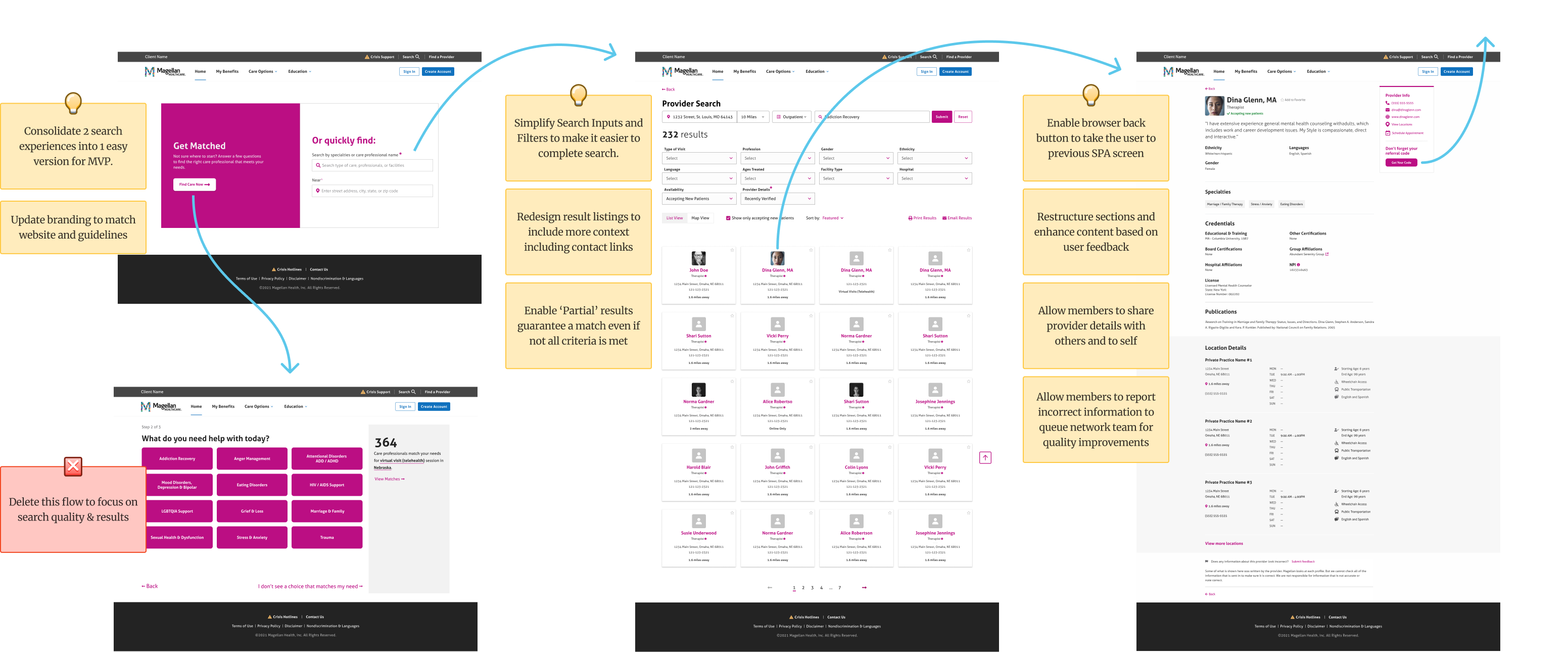
The Provider Search tool is the most valued resource by our customers and members, so it was very important that we addressed the issues that plagued the experience. Luckily, for the last 2 years I had been collecting and categorizing over 2K user feedback entries on this experience so I was very aware of some of the technical, interactive, and conceptual issues our members had with the tool.
The User Pain
We also setup benchmark analytics so that we could understand our search results were performing alongside this qualitative feedback. 60% of all searches yielded 0 results due to search input and filter logic. For the 40% that did receive results, it was difficult to get an appointment with Providers. Their information was either incorrect, or they were no longer accepting new patients. This sank our customer sentiment scores, and it was painful to review the open ended feedback each week.
Project Goals
Our guiding principal was to 'nail the basics' and ensure members had 'gauranteed results' so that they never left without an option that met their needs.

We knew our Provider Search tool was full of issues, but it was difficult in knowing where to start. Our goal was to simplify the experience, to focus on getting a provider match for our members, so we had to backwards from that by identifying ways we could make easy, big wins and iteratively optimize from there.
Frameworks & Deliverables
We already had a ton of research and data collected, organized and ready. toshare out with our product and stakeholder teams to kick off the initiative:
Key Discovery Insight
We found that best way to improve the experience was to remove the 'get matched' multi-step survey search option and focus on our quick search path until we improved our search logic, results algorithm, and overall look and feel to be consistent with the portal it was embedded on. From there, we could iteratively enhance the experience once the experience was more stable and usable.
Cross-Functional Collaboration
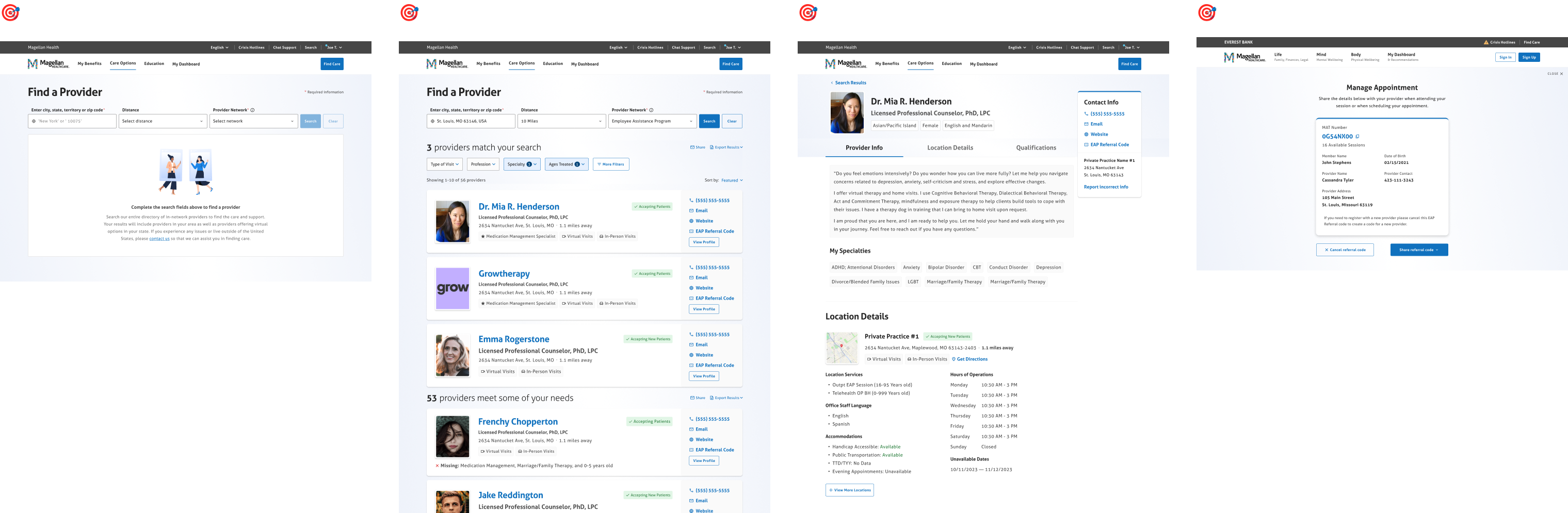
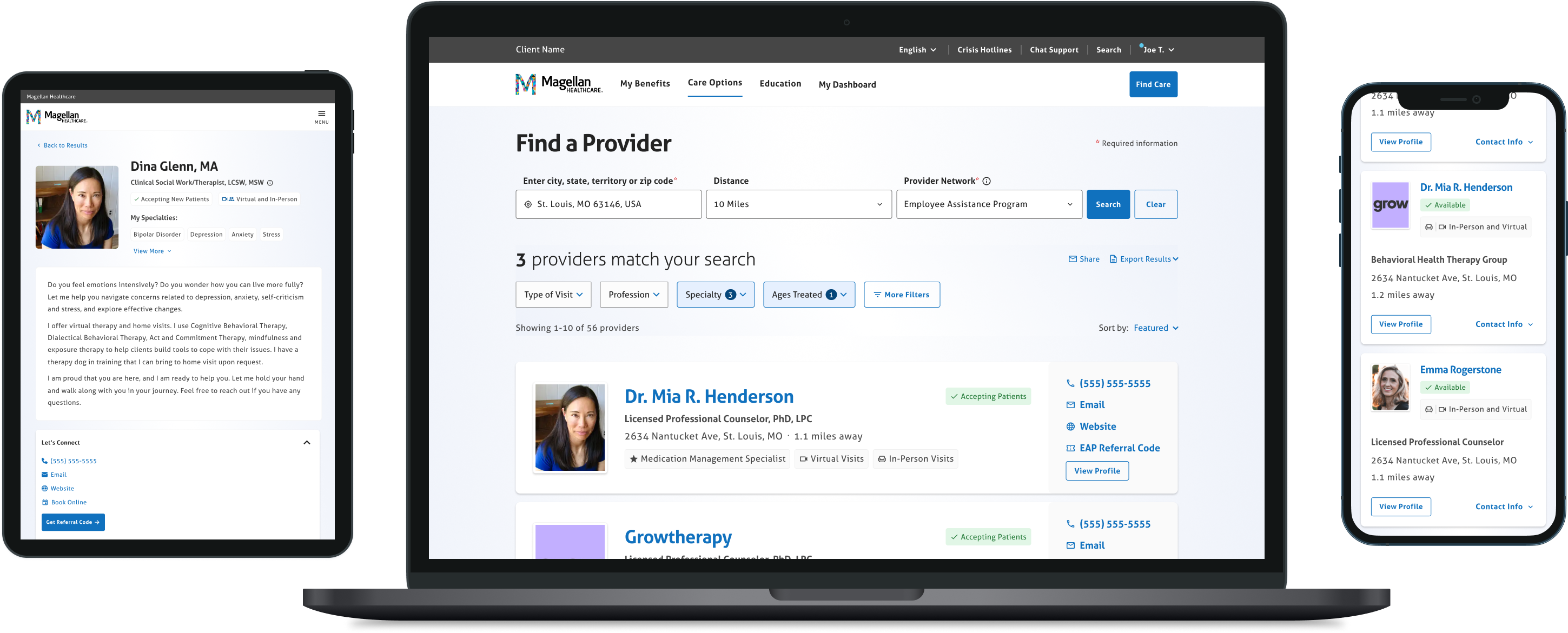
We created a prototype based on what we thought the new V1, simplified version of Provider Search would look like to present to our stakeholders and development teams for feedback. They were thrilled to see us investing in this area and agreed completely with our approach, leading us to feeling very confident going forward.

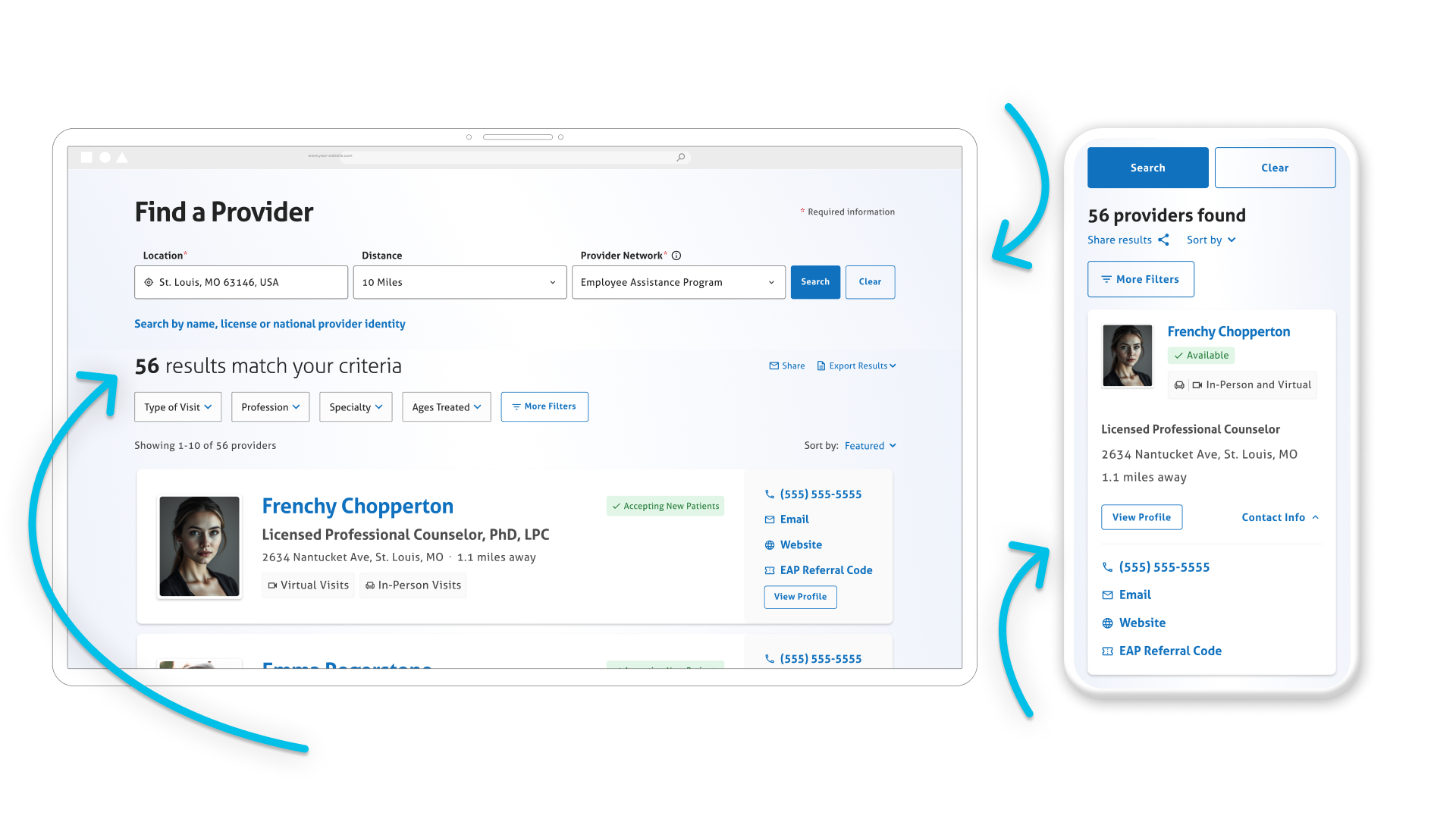
Our V1 prototype was well received by our stakeholders and user testing participants. We were able to make the experience easy to use, and ensure members received results that met most of their needs, however by addressing the major usability issues, we began to uncover additional issues that were more deeply rooted in our backend end systems and network data base.
The Core Design
The prototype included a landing page where members would only enter their location and benefits network to get started. This would allow members to see providers in their network first, and then begin filtering down the results set individually vs doing a full search with filters at once. From there, members could review their results and begin contacting providers from that screen instead of having to click into each in order to get the details needed to proceed.
Key Artifacts
Once the prototype was complete, we were able to conduct usability testing with moderated sessions where members would go through the current experience and raise issues, that our prototype would solve. When an issue was brought up, we'd open our prototype to validate our new solution solves that problem, and collect additional feedback to help guide the next iteration of the prototype.
Measurable Improvement
Through the usability study sessions, we were able to identify the most viable, feasible, and valuable enhancements that would inform our product road map in a strategical way that laddered up to the newly formed future state vision for the Provider Search experience.

Our team was able to able to implement the simplified search experience as part of the strategic road map for this year, however the additional enhancements are scheduled for 2026 where we will begin to see the real value in improving search results, and appointment experience. I'll be sure to update this use case as those enhancements roll out.
Nail the Basics
Our Search Tool went from having 10 screens to 3 screens, enabling us to focus on the core functionality for the search, results, and appointment experience. This reduced the front-end efforts needed by 70% for all accessibility, and consistent styling with our member portal.
Guaranteed Results
While we haven't been able to implement the partial matching logic yet, we have seen an uptick in completed searches by 35% now that there is only 1 path way to receive results. We are highly confident in the scheduled partial match feature set and will report back once implemented.
Improve customer satisfaction
We have received 10% less negative comments in our feedback surveys and in the last month, our CSAT scores have increased by 5% but its too early to know how the enhancements contritubed to that yet. Check back in for updated findings once the additional enhancements have been made.
Even though this initiative is ongoing, I've already learned so much from my experience. First, just because a product feature doesn't have a dedicated time, budget, or enterprise initiative behind it, doesn't mean that there is no potential in making it better. Once the business made this feature a candidate to improve, and we presented the data behind the issues, opportunities, and strategies, it was clear this work would be a top priority.
Going forward, I'm going to do a better job of building up use cases for features that I actively monitor and identify opportunities for. In this case, the key was to synthesize the issues, and connect them to simple solutions that would be easy to develop and produce the most value from our member's perspective.